Stay Connected in the USA from Arrival to Departure
Read more
The first few hours after arriving in the USA are usually filled with practical details. Finding transportation from the airport, locating the hotel, confirming a reservation, or navigating an unfamiliar city often requires internet access sooner than expected.
Most of those things become much easier once the phone is connected to the internet. Internet access is often most useful during the journey itself rather than after everything is already settled.
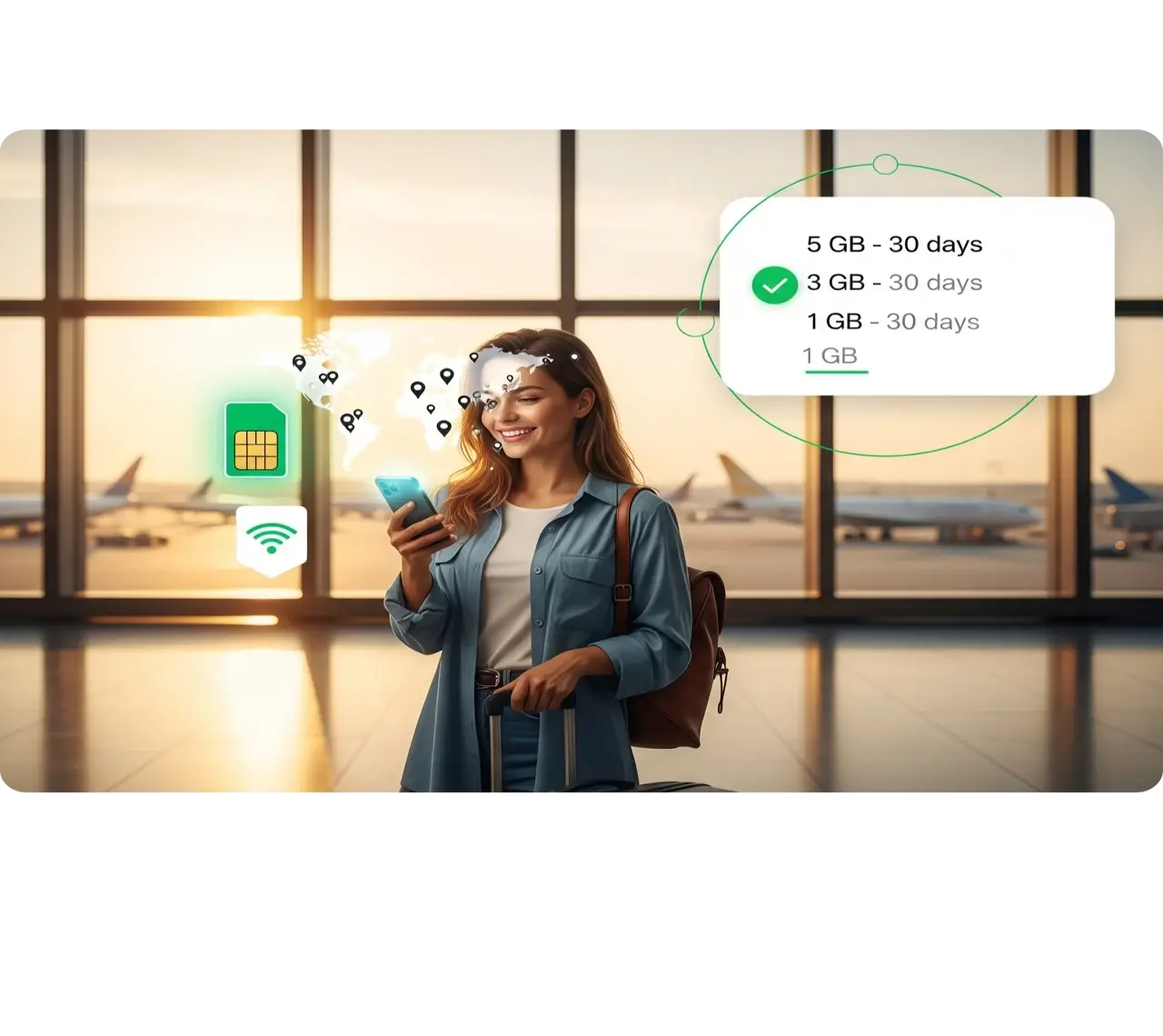
That's one reason many travelers now arrange their mobile data before departure. A USA eSIM makes it possible to get online shortly after arrival without swapping physical SIM cards or relying on expensive roaming services.
Whether the trip starts in New York, Los Angeles, Miami, or another destination, having mobile data available from the beginning can remove a surprising amount of stress from the first day of travel. For many visitors, that's where an eSIM for USA travel starts to make sense.
Find the Best eSIM for Your USA Trip
Read more
Mobile data rarely gets much attention while planning a trip. Then the flight lands. An Uber needs to be booked. A hotel address needs to be found. Someone wants to check directions, look up a restaurant, or message family back home.
Travel habits often look different once the trip is underway. A city break, a cross-country journey, and a month of remote work rarely create the same mobile data requirements.
A few days in New York, a two-week road trip across several states, and a month of remote work in the USA rarely create the same data needs.
Visiting United States for 3–5 Days
A short trip has a way of passing faster than expected. The first day often disappears between the airport, the hotel, and figuring out how everything works. By the second day, the phone is being used for directions, restaurant searches, ride-sharing apps, and the occasional photo upload.
Most visitors staying in one city for a few days don't need as much data as someone traveling across several states. A smaller plan is often enough, especially when hotel Wi-Fi handles part of the workload.
Visiting USA for 1 Week
A week in the USA usually means spending more time away from the hotel.
Somewhere along the way, mobile data starts to handle more than just maps. Tickets get booked on the move, opening hours get checked, and photos find their way onto social media before the day is over.
By the end of the week, the phone often becomes part of daily decision-making, from transportation and reservations to last-minute changes of plan.
Visiting USA for 2 Weeks
Two weeks can feel very different from a short vacation. A trip that begins in New York might end in Miami. Someone else may start in Los Angeles and spend days moving between cities.
Longer trips often create more situations where information needs to be checked on the move, particularly when moving between cities, airports, and accommodations.
That's often when data usage starts looking very different from the original estimate.
Digital Nomads & Business Travelers
Not everyone visits the USA for sightseeing. For some people, the laptop comes along too. A café becomes a temporary office. Video calls happen between meetings. Files are uploaded from hotel rooms late in the evening.
In those situations, mobile data often acts as a backup rather than a convenience, especially when a stable connection suddenly becomes important.
Heavy Data Users
High-data activities tend to reveal themselves quickly during a trip. Some trips barely touch a data plan. Others seem to consume data without much effort at all.
A few days of working remotely, sharing a connection with a laptop, uploading content, or spending evenings watching videos in a hotel room can create very different usage patterns from a typical vacation.
This is usually why heavy data users pay closer attention to plan size before departure than they do to the initial price.
How Much Data Do You Need in the USA
Read more
Estimating data usage before departure is rarely exact. Actual usage often depends on how frequently the phone is used throughout the day.
A traveler planning to use the phone only for directions may end up booking attraction tickets online, checking restaurant reviews throughout the day, ordering Uber rides, uploading photos, and staying connected with family back home.
By the end of a typical day, the phone may have done much more than expected.
An Uber from the airport. Directions to the hotel. A few restaurant searches before dinner. Looking up opening hours for an attraction. Sending photos to friends back home. Maybe a video call in the evening before going to sleep. None of those activities feel unusual on their own. They simply tend to add up over the course of a trip, especially when most of the day is spent away from Wi-Fi.
That's one reason many travelers prefer leaving a little room for unexpected data consumption rather than choosing the smallest possible plan. A plan that looks larger than necessary before departure sometimes feels surprisingly reasonable by the end of the trip.
| Travel Style | Suggested Plan | Typical Usage | Recommended Duration |
|---|---|---|---|
| Short city trip | 3GB – 5GB | Maps, Uber, messaging, restaurant searches | 3–5 Days |
| One-week vacation | 10GB – 15GB | Daily navigation, social media, travel apps | 1 Week |
| Multi-city travel | 20GB – 30GB | Frequent navigation, bookings, photo uploads | 2 Weeks |
| Business travel | 30GB – 50GB | Video calls, cloud services, hotspot usage | 1–3 Weeks |
| Heavy data usage | Unlimited | Streaming, hotspot, large uploads | Any Duration |
The numbers above aren't rules. They're simply the kinds of plans people often end up choosing after looking back at how they actually used their phones during similar trips. Ready to choose your USA eSIM? Take a look at the available plans and pick the one that suits your trip.
USA Coverage Map & Supported Networks
Read more
Coverage rarely attracts much attention during the planning stage, but it can become important once the journey begins. The importance of coverage often becomes clearer outside familiar city environments.
Maybe while waiting for a ride outside the airport. Maybe somewhere on a road trip between cities. Or while trying to check directions in a part of town that's completely unfamiliar.
Many eSIM for United States plans operate through major local networks and provide coverage across large parts of the country. In major destinations such as New York, Los Angeles, Chicago, Miami, Las Vegas, and San Francisco, mobile data is simply something most travelers expect to be available.
The picture can look a little different outside large metropolitan areas. A route through national parks, mountain regions, or remote highways may not always feel the same as spending a week in a city center.
That's one reason many travelers take a quick look at coverage information before purchasing an eSIM for data in the USA, especially when the itinerary includes more than one state or a long-distance road trip.
eSIM for USA Road Trips
Read more
Driving across the United States changes the way mobile data is used.
In cities, losing signal is rarely a concern. There's usually Wi-Fi nearby, whether it's at a hotel, café, or even a gas station. But once you leave the urban core, the situation changes quickly. On long stretches of highway, your phone becomes less of a browsing device and more of a navigation tool you can't afford to lose.
Trips like the Pacific Coast Highway or Route 66 make this difference very obvious. One moment you're in a dense city like Los Angeles or San Francisco, and a short drive later you're surrounded by long, open roads where signal strength can fluctuate without warning. The same applies to cross-state journeys through places like Arizona, Utah, or Nevada.
This is where many travelers misjudge their plan choice. It's not the amount of data that becomes the issue — it's whether the connection holds when you actually need it.
Pro Tip: One detail that experienced road-trippers often pay attention to is the network behind the plan. A large data allowance won't be particularly useful if coverage becomes unreliable once the route leaves major cities. This tends to matter most on long interstate drives, national park routes, and remote stretches of highway where mobile data often becomes part of navigation, trip planning, and day-to-day travel decisions.
eSIM for North America
Read more
Not every trip ends at the US border. Trips across North America do not always stop at one border. It is common for itineraries to include combinations such as the USA and Canada or the USA and Mexico within the same journey.
In those situations, switching SIM cards along the way is usually the last thing people want to deal with. That's where an eSIM for North America can make more sense than a country-specific plan.
A trip doesn't always stop after one country. Someone might spend a few days in New York, then catch a flight to Toronto. Another traveler may cross into Mexico after finishing a road trip in Texas.
Once that happens, mobile data becomes one of those things people expect to keep working without much thought. Available regional plans often cover combinations such as USA + Canada, USA + Mexico, or all three countries together.
Regional coverage often becomes most valuable when travel plans extend beyond a single country. Not while comparing plans, but while standing in an airport, crossing a border, or trying to order a ride in a city that wasn't part of the original itinerary.
USA eSIM vs International Roaming
Read more
Both options can keep a phone connected in the USA, but they work differently in practice. An eSIM plan is chosen and installed before departure, with pricing and data known in advance. Roaming runs through the home carrier, where costs and coverage depend on that carrier's agreements. The table below shows how the two compare on the details travelers usually care about.
| Feature | USA eSIM | International Roaming |
|---|---|---|
| Setup | Installed before departure | Activated through home carrier |
| SIM Card Changes | Not required | Not required |
| Pricing | Usually selected before the trip | Charges may depend on carrier rates |
| Coverage | Based on the selected eSIM plan | Based on roaming agreements |
| Multiple States | Typically works across supported destinations | Depends on the carrier |
| Data Control | Plan details are known in advance | Usage costs may be harder to estimate |
| Activation | Usually done through a QR code | Managed through the mobile provider |
| Popular For | Tourists, road trips, and business travel | Short trips and occasional usage |
How to Activate Your USA eSIM
Read more
Most travelers don't spend much time thinking about activation itself. The important part is usually what happens afterward. Landing in an unfamiliar airport, ordering a ride, finding the hotel, or checking directions to the first destination on the itinerary.
That's why many people prefer to take care of the setup before departure. The QR code arrives by email, the eSIM is added to the phone, and everything is ready before the trip even begins.
By the time the flight lands in the USA, the only thing left to do is switch on mobile data and start using the phone as usual. No searching for a SIM card kiosk. No standing in line at the airport. No trying to figure out mobile settings after a long flight.