Stay Connected in the UK from Arrival to Departure
Read more
Flying into Heathrow or Gatwick is exhausting enough on its own. The last thing you want after a long flight is struggling to figure out train platforms or bus routes into central London.
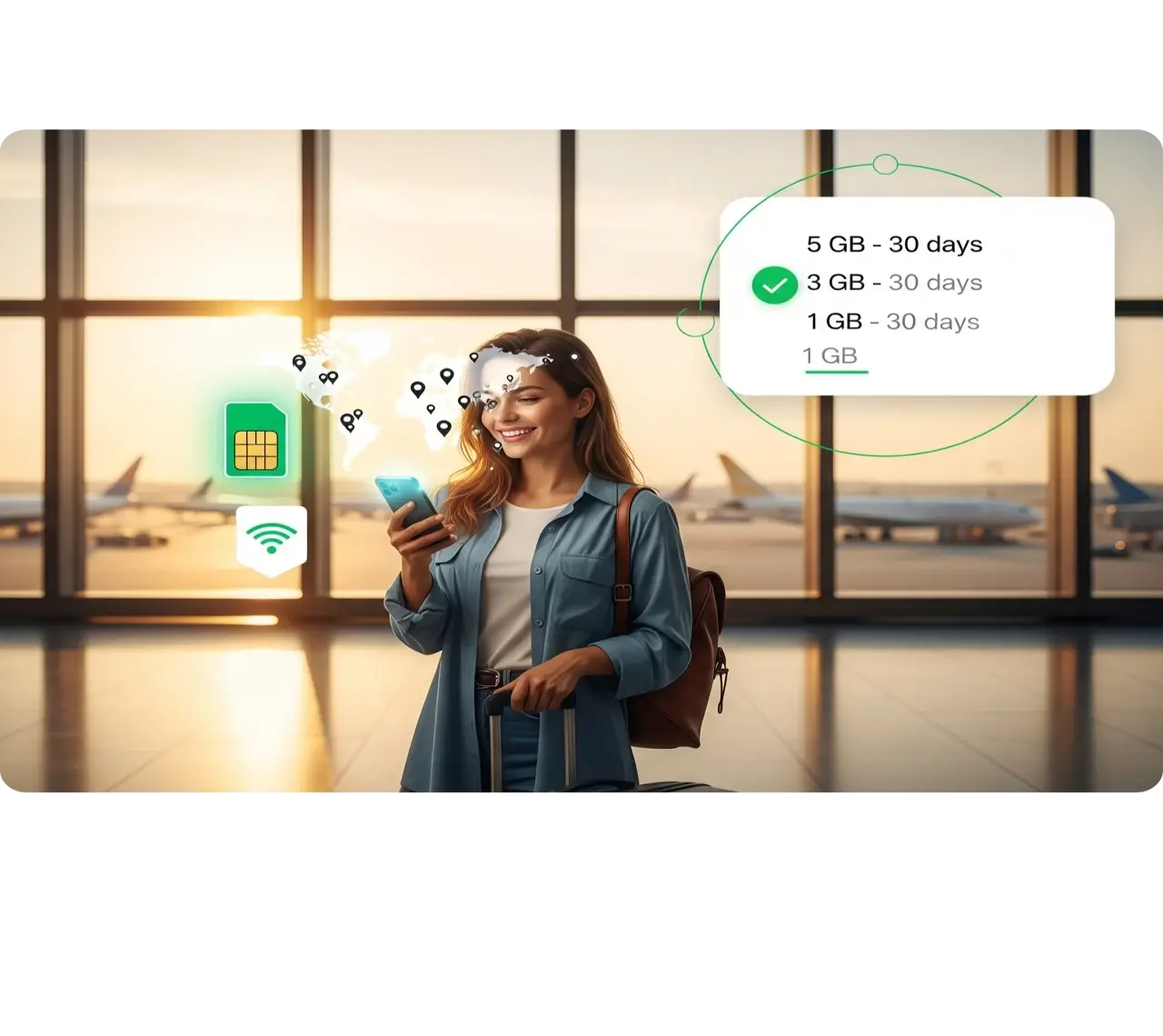
Having your mobile data sorted out before you take off means you can just open your maps, message your hotel, and get moving the minute you step off the plane.
You pull out your phone to look up the platform number or grab a quick ride, but you are instantly stuck because the local airport wireless network demands a text confirmation code you cannot even receive.
Buying a physical SIM at airport kiosks after a long flight often involves long lines and currency exchange fees. Setting up a data profile before departure allows your device to connect to local networks upon arrival.
Why Choose Our eSIM for UK Travel
Read more
Sorting out your mobile internet before you even step on the plane makes your entire British adventure feel infinitely smoother. There is no waiting around for a plastic card to arrive in the mail, and you completely skip the frustration of standing in long airport lines after a tiring flight just to buy a local SIM.
When you choose this modern digital route, the entire process happens instantly from your phone screen. The moment your plane touches down at the terminal, you simply flip a switch in your settings, and you are online immediately.
It also completely outperforms traditional physical cards in terms of daily safety and flexibility. Your regular home SIM stays safely inside your phone slot the whole time, which means you never have to worry about dropping that tiny piece of plastic down a train seat crack or losing it in a hotel room.
You can actually keep your home number turned on to receive critical security codes from your bank, while your new UK eSIM for travel handles all the heavy web searching and map navigation.
Which UK eSIM Plan Should You Choose?
Read more
Selecting the right setup for your British journey depends entirely on how long you are staying and how you use your phone on the road. If you are trying to keep costs low, finding a cheap eSIM for UK travel is incredibly easy because you only pay for the exact amount of days or gigabytes you need.
Budget-conscious travelers can easily grab the cheapest eSIM for UK connectivity without being forced into expensive long-term monthly commitments that local high street shops usually push on tourists.
For those who do not want to constantly monitor their usage while jumping between train lines or streaming music on long journeys, looking into unlimited data options is a massive relief.
If you are just popping over for a fast business meeting or a quick weekend break to see London, a daily eSIM UK plan is probably your best bet.
Longer trips are a completely different story. If you are going to be exploring for two weeks or a month, you need a much heavier data eSIM for UK browsing. Having that extra capacity means you can upload videos, hot-spot your laptop when the accommodation Wi-Fi cuts out, and wander between cities without constantly stressing over a dead connection.
How Much Data Do You Need in the UK?
Read more
Figuring out your data budget before you board your flight saves you from either running out of internet in the middle of a busy street or paying for gigabytes you never actually touch.
A quick weekend break in Manchester requires a totally different setup than a two-week road trip up through the Scottish Highlands, where you will rely on your live maps for hours on end.
| Trip Type & Duration | Suggested Data | Best Used For | Real-World Usage Examples |
|---|---|---|---|
| Weekend Break (2–3 days) | 1 GB – 3 GB | Essential navigation & messaging | ~24 hours of live Google Maps routing or ~50 hours of WhatsApp texting and photo sharing. |
| Short Holiday (5–7 days) | 5 GB – 10 GB | Daily city sightseeing & social media | 1 hour of daily Instagram browsing + 2 hours of live transit routing + ride-hailing app usage. |
| Two-Week Tour (10–14 days) | 10 GB – 20 GB | Intercity travel & HD video calls | ~10 hours of WhatsApp video calling + daily high-res video story uploads + continuous navigation. |
| Extended Stay (30 days+) | 20 GB or Unlimited | Remote work & heavy video streaming | Hotspot tethering for laptop Zoom meetings, large file transfers, and continuous HD streaming. |
Ready to choose your UK eSIM? Take a look at the available plans and pick the one that suits your trip.
Network Speeds You Can Expect Across the UK
Read more
If you are staying around major urban centers like London, Manchester, Birmingham, or Edinburgh, your phone will pick up 5G pretty much everywhere. Real-world download speeds in these city hubs generally range from 100 Mbps to 300 Mbps, which is fast enough to stream video without buffering or to pull up live navigation routes instantly.
Once you hop on an intercity train or drive out toward smaller market towns and countryside highways, coverage shifts mostly to 4G LTE. Speeds out there usually average between 20 Mbps and 50 Mbps.
It is a bit slower than city 5G, but still plenty fast for streaming music on Spotify, sending photos over WhatsApp, or browsing restaurant reviews on the go.
Coverage Across the United Kingdom
Read more
This digital profile works perfectly all over the UK, meaning you never have to mess with your phone settings when crossing regional borders. The network coverage encompasses England, Scotland, Wales, and Northern Ireland, meaning you stay connected under a single plan no matter how far your itinerary takes you.
Your phone links directly to local British networks as you travel, keeping your connection steady for maps, browsing, and messaging.
However, it is worth keeping in mind that the British landscape includes some very rural and rugged terrain. If you are traveling through the deep valleys of the Scottish Highlands, wandering remote coastal paths in Wales, or driving through isolated patches of the countryside, the signal strength can naturally vary depending on which local mast is closest.
Having a reliable eSIM for travel in the United Kingdom ensures you are well covered for most of your journey, but downloading your driving directions for offline use before heading deep into nature is always a smart backup plan.
eSIM for England
Read more
England is the largest destination for most visitors, and having a dedicated eSIM for England browsing ensures your phone works perfectly from the moment you leave the airport terminal.
Whether you are navigating the historic streets of Bath, photographing the stone architecture in Oxford, or exploring the vast lakes in Cumbria, a reliable data connection is essential.
Live mobile data makes getting around London a lot smoother, especially for transport apps. It's just as useful if you're taking trips out to places like Manchester or Oxford and need quick directions on the go.
In London, continuous data access helps with tracking real-time bus arrivals, navigating Underground connections, and booking digital tickets for attractions.
UK Mobile Networks
Read more
When you travel through the UK, your phone hooks straight into the exact same signal towers that locals use every day. The British mobile market is built around several major providers, and your device automatically searches for the strongest signal depending on where you happen to be standing.
- EE (BT Group): Widely recognized for having the broadest geographical coverage and fastest overall speeds across the UK, especially when traveling outside major towns into rural areas, national parks, and the Scottish Highlands.
- Vodafone: A massive global network that offers exceptional, rock-solid reliability within major towns and along the busiest commuter lines.
- Three: Provides solid data capacity in built-up urban areas, making it a reliable option for daily city browsing.
- O2: This is the network powering millions of UK phones, and it is particularly great at getting a decent signal inside thick brick buildings or around historic, narrow city streets.
- 5G Speed: You will mostly see this pop up when you are hanging out in big places like London, Manchester, or Edinburgh.
- 4G Coverage: Once you jump on an intercity train or head out onto the motorway, your phone will mostly rely on these networks.
Instead of being stuck on just one network the whole time, a solid UK eSIM for data usage lets your phone automatically jump between whatever tower and speed happen to be strongest wherever you are standing.
Practical UK Connectivity Guide: Real Traveler Questions
Read more
How to navigate the London Underground without losing signal?
Pull up your route on Citymapper or Google Maps before walking down to the platforms. Signals often cut out in deep tunnels, so loading your route ahead of time keeps your directions visible even when offline.
Is coverage weak in the Scottish Highlands and the Isle of Skye?
It varies depending on the landscape. Main roads, larger towns like Inverness, and central spots on Skye (like Portree) get solid 4G. However, drive into mountain passes, deep valleys, or remote coastal trails, and your signal will drop. Downloading offline maps before heading out is always a good idea.
How much data does Google Maps actually use?
Very little if you plan ahead. Downloading offline maps on hotel Wi-Fi means live GPS barely touches your data balance while driving or walking around.
Is a travel data plan sufficient for WhatsApp voice and video calls?
Yes, easily. WhatsApp voice calls only use about half a megabyte per minute, while video calls take roughly 3 to 5 MB a minute. A standard data package covers hours of calls back home without burning through your gigabytes.
Planning to Travel Beyond the UK?
Read more
If your British vacation is just the first stop on a larger backpacking adventure or a multi-country holiday, you need to think about how you will stay connected once you cross the English Channel.
Many travelers head straight from London to continental Europe to explore historic ruins or relax on Mediterranean beaches. If that is your plan, looking into a broader eSIM for International Travel before you leave home will save you from having to purchase multiple local profiles for each country you visit.
For those who are mapping out specific itineraries across the continent, getting a regional eSIM for Europe is often the smartest move because it allows your phone to hop across borders seamlessly without any service drop-offs. For instance, you can fly from Manchester straight into Rome and have your eSIM for Italy activate the second you land, letting you look up transit routes to the Colosseum instantly.
The same goes if you are heading southwest for some sun; switching over to a dedicated eSIM for Spain ensures you have high-speed data ready for navigating the busy streets of Madrid or finding a tapas bar in Barcelona without relying on unsafe public Wi-Fi networks.
Crossing Borders: How UK Plans Handle Mainland Europe
Read more
Ever since Brexit, standard UK carriers brought back extra roaming fees for locals heading over to Europe. But if you are visiting as a tourist on a prepaid travel profile, how your data behaves across borders depends entirely on what type of package you buy before taking off.
If you purchase a single-country UK profile, your internet connection will stop working the minute you leave British territory. Crossing the English Channel into France, flying over to Dublin, or hopping on a flight to mainland Europe cuts off your data until you purchase a new package.
Travelers heading on a multi-stop itinerary, like taking the Eurostar from London to Paris or flying on to Amsterdam, usually do much better with a regional European option instead.
It automatically connects to local national providers as you jump between countries, keeping your maps and messaging active without needing to reconfigure any settings mid-trip.
Practical UK Travel Insights
Read more
- Arriving at Heathrow or Gatwick: Live data lets you fire up Citymapper or Google Maps the second you land. Finding your platform or exit at massive hubs like Paddington or King's Cross gets confusing fast, so real-time app directions save a lot of walking around in circles.
- Driving Through Rural Scotland: Always download offline routes on Google Maps or Maps.me while on hotel Wi-Fi in Glasgow or Edinburgh before driving into the Highlands, Isle of Skye, or Cairngorms. Signal cuts out frequently along mountain passes and quiet glen roads.
- Signal Inside Historic Buildings: Thick stone walls in older places like Bath, Oxford, or Edinburgh tend to block cell signals. If your data drops inside an old pub or basement café, walking toward a window or stepping outside usually fixes it immediately.
- Transit & Digital Tickets: UK train barriers and bus drivers expect quick scans of digital QR passes or phone payments. Active data stops you from digging through screenshots or dealing with frozen ticket apps while people wait behind you.
How to Activate Your UK eSIM
Read more
Setting up your new digital connection only takes a few minutes, and you do not need to wait until you land in the UK to start.
Before you buy a plan, you need to make sure your smartphone can actually use this technology and is not locked to a specific home carrier. You can quickly double-check this by looking at our guide on eSIM Compatible devices to see if your specific phone model is ready to go.
Once you know your device is good to go, just follow these simple steps to get connected:
- Scan the setup code — Open the cellular or mobile data settings on your phone, select the option to add a new data profile, and scan the QR code that arrived in your email right after you checked out.
- Give your profile a clear nickname — Go into your network settings and label the new line something obvious like UK Data. This keeps you from guessing which line is which when you are trying to change settings later.
- Keep your home SIM active — Leave your regular physical card or home line turned on in the background.
- Switch on data roaming at landing — Make sure to flip this switch the second your plane is taxiing to the gate in London.
Frequently Asked Questions for UK eSIM
Can I activate before arriving?
What happens when my data finishes?
Is UK eSIM better than roaming?
What is an eSIM for UK?
Can I use an eSIM in London?
Can I keep my WhatsApp number with a UK eSIM?
Does this eSIM include calls and SMS?
Can tourists buy a UK eSIM?
Will my UK eSIM work in England, Scotland, Wales, and Northern Ireland?