The Short Answer
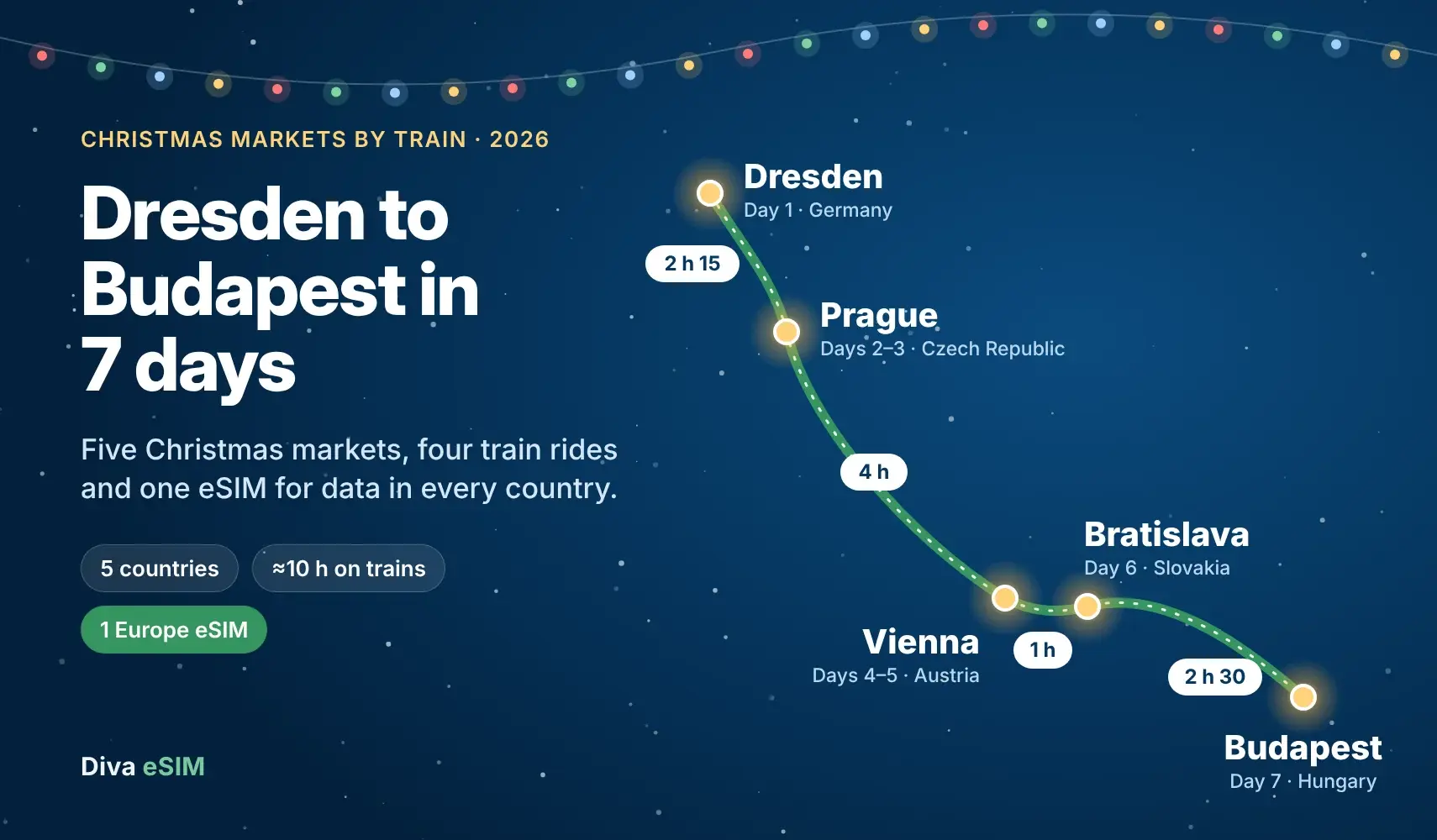
Yes, you can visit five Christmas markets in five countries in seven days by train, with one Diva eSIM for the whole trip. The route is Dresden, Prague, Vienna, Bratislava and Budapest, with just under 10 hours on trains spread over four travel days.
All five main markets are open together from Saturday 28 November to Wednesday 23 December 2026. Spend one night in Dresden, two in Prague, two in Vienna and one in Bratislava, and end in Budapest on day 7. Every active Diva eSIM Europe plan covers Germany, the Czech Republic, Austria, Slovakia and Hungary, so you install once and don't need a new plan at any border. Below you'll find the 2026 dates and opening hours, the trains, and the phone side of a self-guided Christmas market tour of Europe: cold evenings, crowded squares and night photos that eat data. New to eSIMs? Start with what a travel eSIM is.
Christmas Markets in Europe by Train: The Route at a Glance
We checked the dates, opening hours and train times for this guide on 7 November 2026, and each city section links the official market page. Programmes can change, so check again before you travel.
| Day | City | Main market and 2026 dates | Train that day |
|---|---|---|---|
| 1 | Dresden, Germany | Striezelmarkt, Altmarkt: 25 Nov to 24 Dec 2026 | Arrive in Dresden |
| 2 | Prague, Czech Republic | Old Town Square and Wenceslas Square: 28 Nov 2026 to 6 Jan 2027 | Dresden to Prague, direct, about 2 h 15 min |
| 3 | Prague | The same markets, plus Republic Square (from 25 Nov) and Peace Square | No train |
| 4 | Vienna, Austria | Rathausplatz: 13 Nov to 26 Dec 2026 | Prague to Vienna, direct Railjet, about 4 h |
| 5 | Vienna | Schönbrunn Palace: 6 Nov 2026 to 6 Jan 2027 | No train |
| 6 | Bratislava, Slovakia | Main, Franciscan and Primate's Squares: 27 Nov 2026 to 3 Jan 2027 | Vienna to Bratislava, regional train, about 1 h |
| 7 | Budapest, Hungary | Advent Bazilika: 13 Nov 2026 to 1 Jan 2027; Vörösmarty Square: 13 Nov to 31 Dec 2026 | Bratislava to Budapest, direct EuroCity, about 2 h 30 min |
When to Go: Christmas Markets 2026
The route works as written between Saturday 28 November and Wednesday 23 December 2026. Prague's two main markets are the last to open, on 28 November. At the other end, Dresden's Striezelmarkt closes at 2 pm on 24 December and Vienna's Rathausplatz market ends on 26 December, so a start after 23 December loses the first stops.
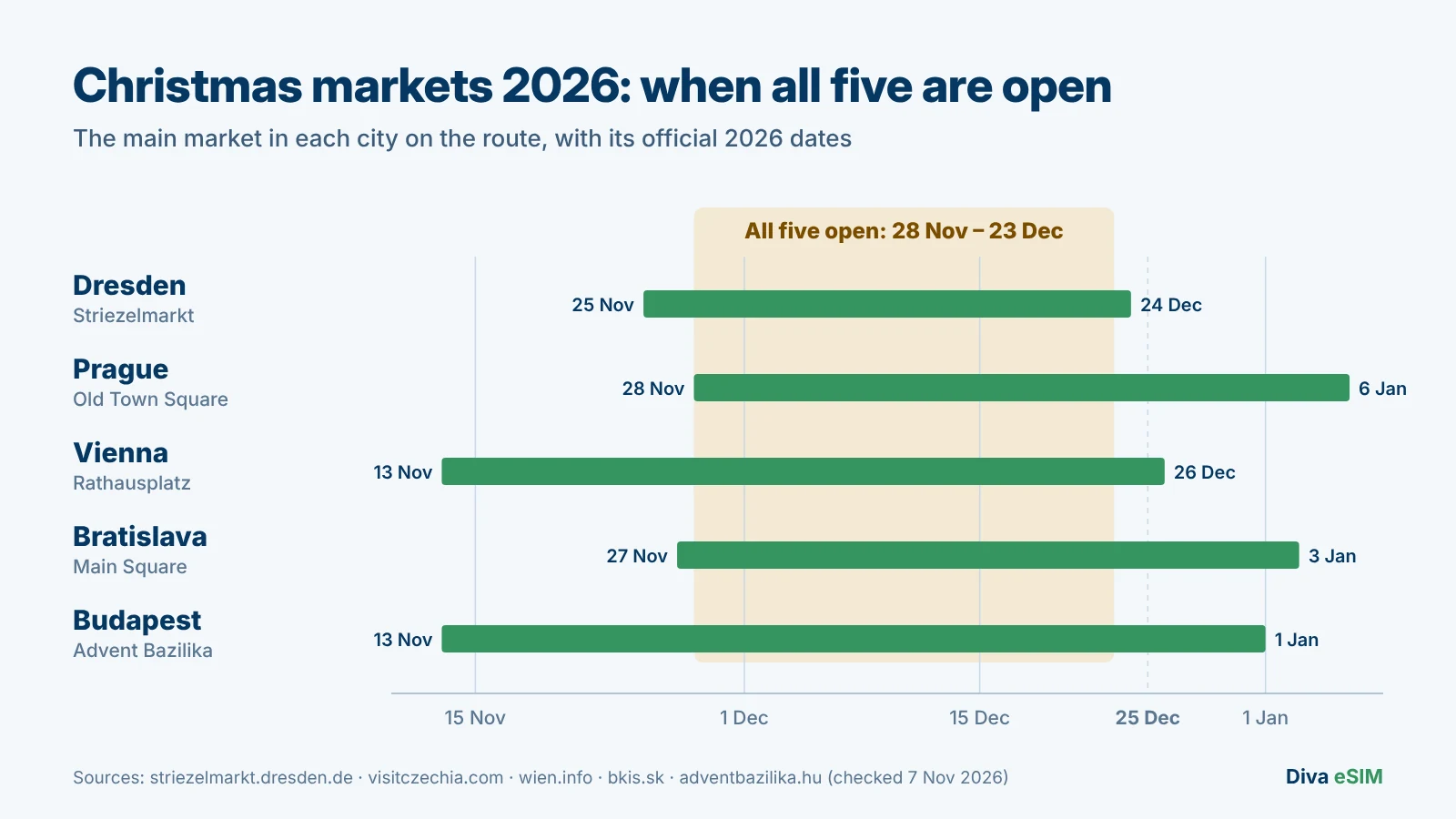
The Advent Sundays in 2026 fall on 29 November and 6, 13 and 20 December. If you want to be at a market on one of them, plan your days around those dates. One date is worth building the whole trip around: the Dresdner Stollenfest on Saturday 5 December 2026, the Saturday before the second Sunday of Advent. Start in Dresden that day and the rest of the route follows.
Sunset is around 4 pm in all five cities in December. The lights come on early, which is good for photos. It also means hours outside in the cold with your phone in your hand, which is why the second half of this guide is about keeping it working. Travel in the morning where you can, and keep the late afternoon and evening for the markets.
Day by Day: A 7-Day Christmas Market Itinerary Through Europe
Day 1: Dresden Christmas Market (Striezelmarkt)
Start in Dresden. The Striezelmarkt on the Altmarkt was first recorded in 1434, and 2026 is its 592nd edition. It runs from 25 November to 24 December 2026, daily from 10 am to 9 pm, according to the City of Dresden. On opening day, 25 November, it opens at 4:30 pm, and on 24 December it closes at 2 pm.
Dresden Hauptbahnhof, the main station, is about a 10-minute walk from the market, so you can drop your bags and be there before dark. If your dates allow, be here on Saturday 5 December for the Stollenfest. Germany uses the euro. Official site: striezelmarkt.dresden.de.
Days 2 and 3: Prague Christmas Market 2026 (Old Town Square and Wenceslas Square)
Take a morning train from Dresden to Prague. It's direct, takes about 2 hours 15 minutes and follows the Elbe valley for much of the way, so sit by the window. You get two afternoons and one full day here.
Prague's two main markets, on Old Town Square and Wenceslas Square, are a few minutes' walk apart and run from 28 November 2026 to 6 January 2027. Use day 2 for Old Town Square after dark and day 3 for the smaller markets, which are quieter and more local: Republic Square (Náměstí Republiky) opens earlier, on 25 November, and Peace Square (Náměstí Míru) is in Vinohrady. The smaller markets close on or before 24 December. Official listing: visitczechia.com.
The Czech Republic uses the koruna (CZK), not the euro, so this is where a banking app on your phone starts earning its keep. For mobile data in the country on its own, see our Czech Republic eSIM page.
Days 4 and 5: Vienna Christmas Market 2026 (Rathausplatz and Schönbrunn)
Prague to Vienna is the longest leg: about 4 hours on a direct Railjet that calls at Brno. Railjets have free Wi-Fi, but keep your own data on as well, so maps and messages don't depend on it.
The Wiener Christkindlmarkt on Rathausplatz, in front of City Hall, runs from 13 November to 26 December 2026, daily from 10 am to 10 pm (10 am to 6:30 pm on 24 December). The Eistraum ice rink next to it is open from 13 November 2026 to 6 January 2027. On day 5, head to Schönbrunn Palace: its market runs from 6 November 2026 to 6 January 2027, is open from 10 am to 9 pm until 23 December, and is free to enter. In the evening, try one of the smaller markets in the old lanes of Spittelberg or on Am Hof square.
Austria uses the euro. Official listing: wien.info. Staying longer? See the Austria eSIM page.
Day 6: Bratislava Christmas Market
Vienna to Bratislava takes about an hour. REX8 regional trains run hourly from Wien Hauptbahnhof to Bratislava hlavná stanica, and there's also the REX6 to Bratislava-Petržalka, a different station. No reservation is needed: buy a ticket and board. Route details: seat61.com.
Bratislava Christmas runs from 27 November 2026 to 3 January 2027 on Main Square (Hlavné námestie), Franciscan Square and Primate's Square. The old town is compact, so you can walk between all three in one evening. Try lokše (potato pancakes) and kapustnica (Christmas cabbage soup). Slovakia uses the euro. Official site: bkis.sk.
Day 7: Budapest Christmas Market 2026 (Advent Bazilika and Vörösmarty Square)
Bratislava to Budapest is a direct EuroCity of about 2 hours 30 minutes, running along the Danube for much of the way. Budapest has two main stations, Keleti and Nyugati, so check which one is on your ticket before you plan your walk.
Advent Bazilika, in front of St Stephen's Basilica, runs from 13 November 2026 to 1 January 2027, with a giant Christmas tree, light displays and a programme every day. The organiser says it has been voted Europe's best Christmas market four times in a row. Vörösmarty Classic Xmas on Vörösmarty Square runs from 13 November to 31 December 2026 and is about a 10-minute walk away. Hungary uses the forint (HUF). Official site: adventbazilika.hu. For Hungary on its own, see the Hungary eSIM page.
Trains, Tickets and Stations
Doing the Christmas markets by train is simple on this route: four legs, all direct, just under 10 hours in total.
- Dresden to Prague: direct EuroCity or Railjet, about 2 hours 15 minutes.
- Prague to Vienna: direct Railjet via Brno, about 4 hours, with free Wi-Fi on board (České dráhy).
- Vienna to Bratislava: REX8 regional train, about 1 hour, hourly, no reservation.
- Bratislava to Budapest: direct EuroCity, about 2 hours 30 minutes.
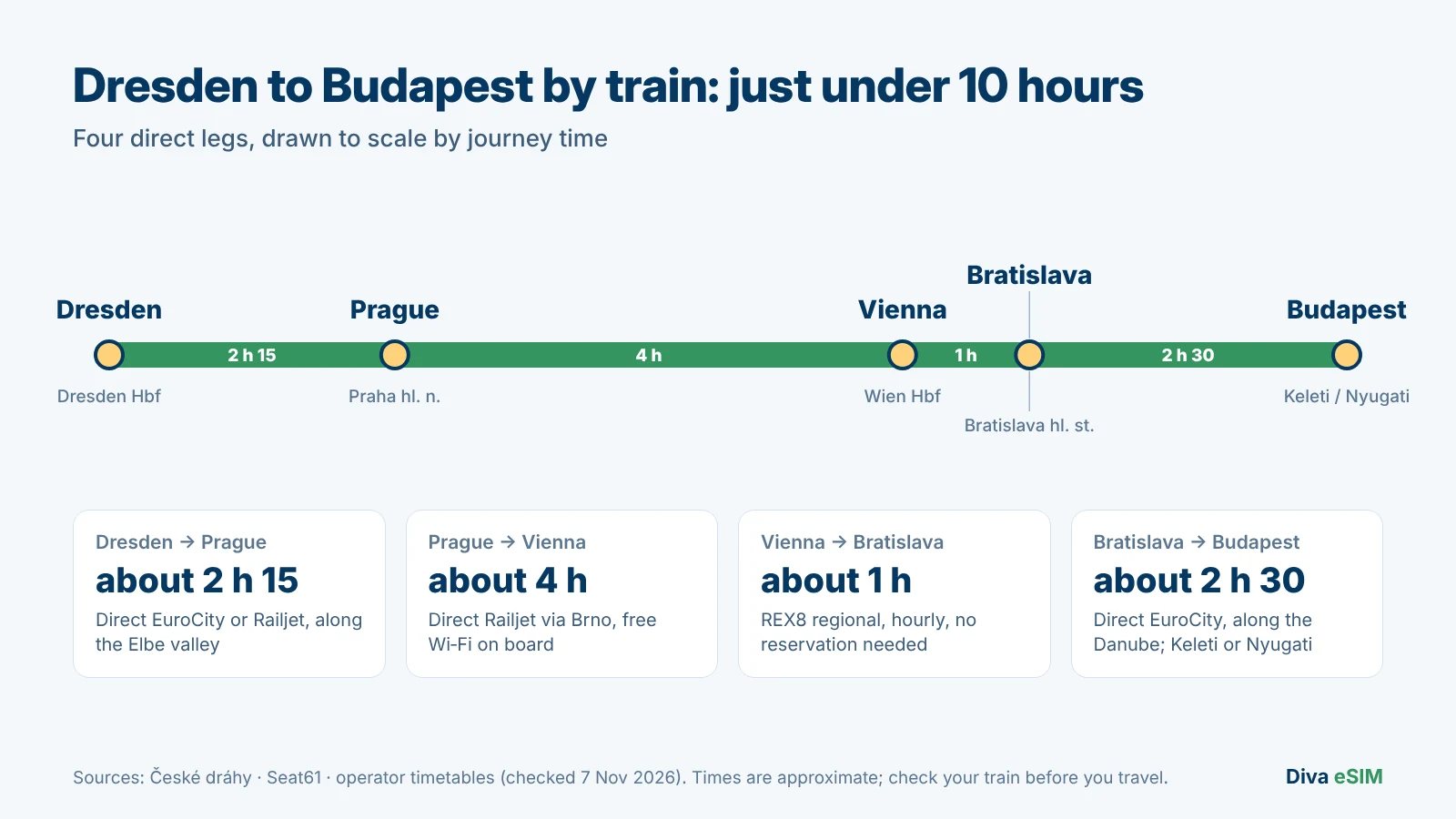
We don't list fares, because they depend on your date and when you book. Check the operator or a booking site. Before each departure, open the operator's app or website to confirm the train, the platform and any changes, and check the station on your ticket: Dresden Hauptbahnhof, Praha hlavní nádraží, Wien Hauptbahnhof, Bratislava hlavná stanica or Petržalka, and Budapest Keleti or Nyugati.
You cross three currencies on this route: the euro in Germany, Austria and Slovakia, the koruna in the Czech Republic and the forint in Hungary. Train tickets, banking apps and currency checks all run through your phone, which is another reason to sort out your data before you leave.
One eSIM for Five Countries
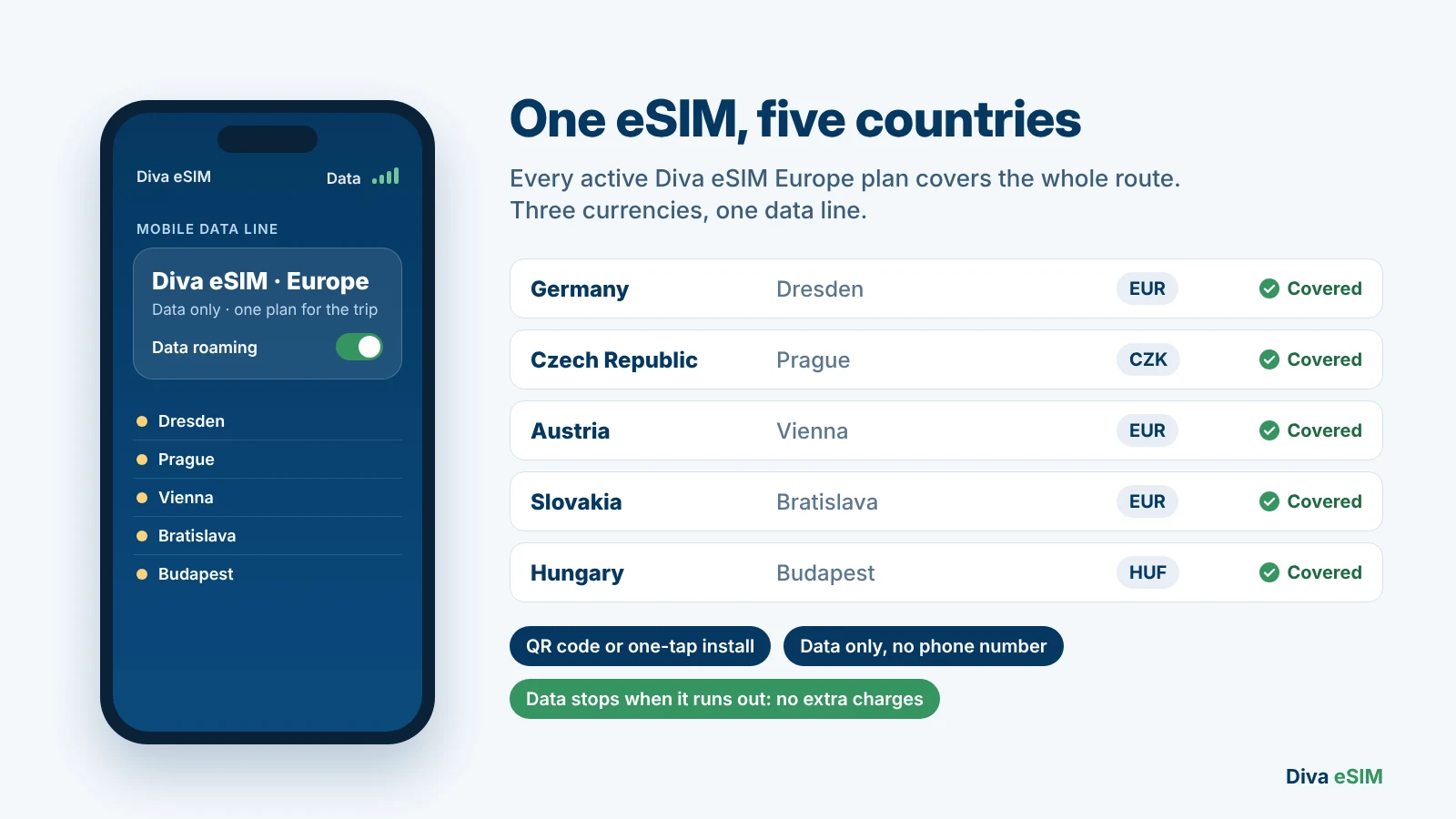
Four borders in seven days is where phones cause the most trouble on this trip. Every active Diva eSIM Europe plan covers all five countries on this route, so one eSIM keeps you online from Dresden to Budapest.
Set It Up in 3 Steps
- Check your phone and pick a plan. Confirm your phone supports eSIM on our compatibility page and check it isn't locked to your carrier, then pick a plan size for your trip on the Europe plan page. There are 7-day Europe plans in several sizes, including an unlimited option.
- Install it before you leave. Your plan comes with a QR code and a one-tap install link. Follow our guide for iPhone or Android while you have a good connection, so it's ready when you land.
- Switch to it when you land. Set the Diva eSIM as your mobile data line and turn on data roaming for that line. Europe plans are data only, with no phone number, so keep your home SIM switched on if you want calls and texts, and keep data roaming off on it.
Crossing the Borders
There's nothing new to buy at the Czech, Austrian, Slovak or Hungarian border. After each crossing, your phone should connect to a supported network in the new country by itself, usually within a few minutes. If your data doesn't come back:
- Turn airplane mode on and off, so the phone searches again.
- Check that the Diva eSIM is still selected for mobile data.
- Check that data roaming is on for the Diva eSIM line.
- Restart your phone.
Thinking of relying on your home carrier instead? The EU's "roam like at home" rules cover SIM cards from EU countries only. US, Canadian and UK carriers set their own roaming prices, often as a daily fee. Our guide to avoiding roaming charges walks you through the options.
How Much Data Do You Need?
How much data you need depends mainly on uploads. Maps, train tickets, translation and messages are small. Photos and videos taken after dark are large, and uploading them as you go is what uses the most. If you back up to the cloud over mobile data or post video every evening, pick a larger plan or the unlimited option. If you upload on hotel Wi-Fi and use data mainly for maps and messages, a smaller plan will do.
Two things keep the risk low. When a plan's data runs out it simply stops: there's no automatic top-up and no extra charge. And Europe plans can be topped up, so you can add more data if you use more than you planned.
Phone Tips for European Christmas Markets
A Christmas market trip through Europe is hard on phones. The markets are cold, dark by 4 pm and busy. These five habits help.
- Download offline maps before each city. In a packed square your map can be slow to load. Save each city for offline use in Google Maps the night before (how to download offline maps). Your eSIM still handles messages and live directions.
- Keep your phone warm. Apple says that in a very cold environment you may notice a decrease in battery life, and that this is temporary (Apple battery guidance). Carry your phone in an inside pocket, close to your body, take it out to shoot, then put it back.
- Carry a power bank. You'll be out from mid-afternoon to late evening with the screen on for maps, tickets and photos. A charged power bank keeps the evening going.
- Shoot now, upload later. Set your photo app's backup to wait for Wi-Fi, then upload at the hotel or on the Railjet. If you want to post as you go, choose a bigger plan.
- Keep tickets reachable offline. Open each ticket in its app before you leave for the station, and keep the PDF or booking reference somewhere you can find without a connection.
Frequently Asked Questions
Yes. Every active Diva eSIM Europe plan covers Germany, the Czech Republic, Austria, Slovakia and Hungary. You install it once and don't need to buy anything at the borders.
Comments (0)
Leave a comment